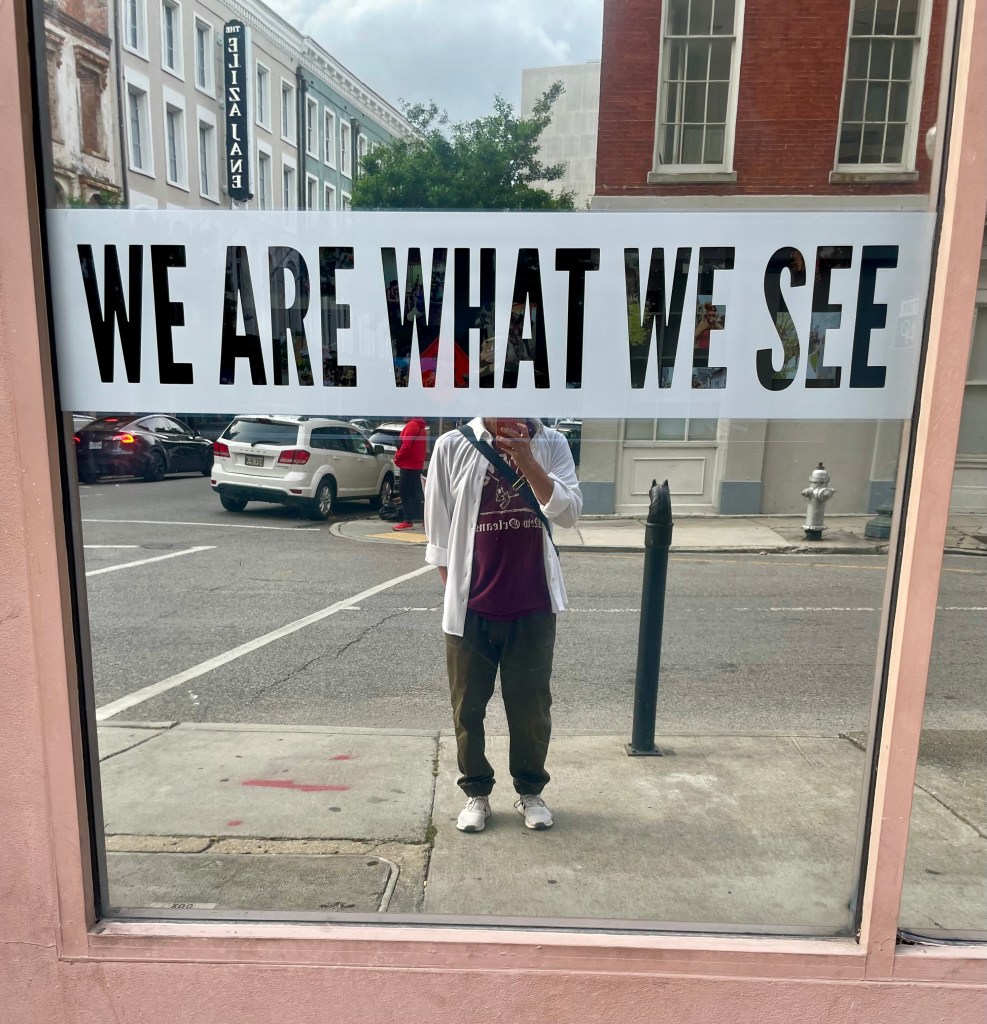
Thirty Years, One Paradigm

Thirty years is a long time to work inside a single paradigm. Long enough to map its terrain. Long enough to see its walls. And eventually, long enough to know it is time to leave.

In The Structure of Scientific Revolutions, Thomas Kuhn describes how scientific progress is not a smooth, linear accumulation of knowledge. Instead, it advances through revolutions. Old models grow brittle under the weight of anomalies. Then comes the shift—a break, a reformation, a new lens.

What a gift we’ve been given. For all the upheaval and uncertainty of recent years, we have also inherited a rare moment: the chance to see with fresh eyes. The noise of collapse has cleared the space for clarity. We are no longer bound by the assumptions baked into our Industrial Revolution mindset—about scale, standardization, or the shape of learning. We get to ask again: what is this for? Who is this for? What does value look like now?

This is not a post about disillusionment. It is about clarity. You don’t abandon a paradigm because it failed. You leave because it succeeded in getting you to its limits.

For years, I tracked the fault lines: the metrics that no longer measured, the tools that shaped the problem more than solved it, the language that constrained what we could imagine. I borrowed from startups, strategy, anthropology, design. I traced the vectors of what could be, and wrote them down, one post at a time.

Now, I find myself standing in the very intersection where those vectors converge. Not with a new paradigm to declare—Kuhn said revolutions are recognized in hindsight—but with a conviction: the next lens is not an extension of the old one. It is orthogonal. It is felt before it is named.

So this is the final post. It is no longer valuable to run learning better. Optimization is deck chair shuffling. We have been given a gift.

I don’t pretend to know what’s next. But I will say: if you’ve read these posts, you already know where I’m going.

learn fast—J.

Pep talk to myself: Learning means business.

The training industry can be underestimated. One individual’s journey from a sports bar chain to venture capitalism reflects a shift in perspective. Learning, data and growth are interconnected. Applying a fractal first principle, learning should be at the core of all endeavors. Technology has advanced learning methods, but a new paradigm is needed for future progress.

I didn’t even know the training industry existed when I got my job at The Forum Corporation thirty years ago. And I had already stumbled around its edges.  When I was running a small sports bar chain in my twenties I had built employee manuals and onboarded a lot of employees.  Later, I helped a friend of my Mom rewrite a sales training course. but I still had no idea there was a billion dollar industry where companies paid millions for products and services every year. There had never been a box labeled training on any organization chart I saw in business class.  We had never discussed a company’s training as part of investment analysis when I was a stockbroker. Even today I find it hard to convince others that this area is a treasure trove. My pitch, “Why only invest in Ai when you can also invest in the real thing?” receives only polite nods. 

I understand the apathy. Even after working for Forum and getting the amazing opportunity to see inside the learning organizations at a host of tech and finance giants worldwide I didn’t believe the potential. Which is why I left to go into venture.  Incremental strategies for internal departments loaded down with legacy baggage seemed tedious compared to the wide open playing field of venture during the first dot-com boom. People understood what I did for the first time. I was surrounded by optimists convinced they could change the world, not realists that were fighting to change a century of entrenchment in a model built for a different time. And just when I thought I was out of learning for good, I was in an airport watching a live Twitter AMA with Eric Ries, the godfather of the Lean Startup movement.  During the chat Ries said a start up, “is just an organization built to learn.” With that one sentence I realized that what I had thought were two synergistic but separate career paths were in fact the same one.

Two loves fueling learning

Our love of data comes from a love for feedback. Our love of looking at ourselves. Reflection, following action, for the purpose of learning to improve. It is our glance at the mirror after we have donned an outfit, the yearning for likes and retweets, the eagerness with which we await conversions stats or A/B test results. Our huge efforts of quantification, and all too often rationalization, are to complete this Action-Reflection cycle.

Our love for growth requires that we learn new things; new markets, new products, new skills, new ways of working. Learning is not a department to be buried levels deep in an organization chart. Nor is it an activity to only occur for a few hours every year in formal experiences designed for information sharing and based on simple stimulus-response mechanisms. CEO’s are the chief facilitator of learning, directing its focus and providing its resources through budgets, people and the example they set.

As both organizations and individuals, we are learning all the time. It is obvious to me that on any scale, from organism to organization to society, learning is the key to success.   

Fractal first principle: Always build for learning. 

Let’s Build Smarter

The brute force and networking phase of advancement is over. We have tapped into the world’s knowledge bases and technology has given us tools to see patterns shaped by more data points than our optimized-for-chunk memory can comfortably hold. We have optimized the old.  Put classes on line (distribution), improved presentations (media), customized for the learner (pathing). From blackboards, to overhead projectors to Powerpoint and now to video, technology has made the same old thing look shiny and new.  It’s time for something more than Moore’s law to move us forward. We have incremented our way to the frontier but now we need more than a new product or distribution channel we need a new paradigm.  

We’ve learned a lot in the last couple of centuries. We learned that we were made of atoms and how to harness and abuse that atom. We learned that even the smartest of us (looking at you Newton) can be wrong. We learned we could build anything our imaginations could put into a sci-fi novel. We learned to survive, conquer, and exploit nature. We learned how small we are in the universe and how big we are on the planet. We learned that the Pax Romana was a bigger accomplishment than we thought. We learned we are so similar and so different. We learned we can live longer. We learned length really doesn’t matter.  We learned we are not the center of the universe. We learned that we still think we are. We have learned our way out of our biggest problems (got my eye on you famine). Look at what we accomplished with just a little bit of learning. Imagine what we could with a little bit more.

Reminder: The future of learning is our future. Let’s build the future. 

2024 Look Ahead

As you pack away the holiday decorations and get back into the flow here are the three vectors I am watching, and building on, this year: Open, Generative and Feral.

“Taken individually, the three vectors described in this report have the potential to create new category leaders and reshape the industry. Taken together, they offer a huge opportunity for learning professionals.”

I welcome comments, informed criticisms, attaboys, DMs and any contribution to this generative experiment. I believe in the power of learning. And right now, it is a super power we need more than ever.

Last year’s report

Last Year’s Debrief


2023 Look Back

Review of last year’s themes: Video, Skills and M*verse.

In preparation for publishing my thoughts for the upcoming year I took some time to review last year’s themes. My macro drivers, first published in 2021 remain changed, as does my unrewarded optimism regarding how fast the impending shift in L&D will take. Trajectories remain more important than current location (more on that in this year’s letter). Especially in an industry with a history of chasing.

If you want to refresh yourself on last year’s report it is available here.

Theme 1: Skills

Of all the themes discussed this shift is most readily obvious. With multiple efforts underway and headlines full of, “the the need for”, “the lack of” and “the power of”, skills, not degrees, are the currency of the worker.  The true value of moving to a skills-based will only be seen when there is a shared standard. While proprietary definitions may be helpful for improved management at the individual company level the lack of transferability means potential talent pools will continue to be overlooked.

Lack of a common ontology also means that third-party learning solutions will struggle to readily identify where they are adding value between organizations and geographies. I am a big fan of standards at this foundational level and L&D has already seen the importance and benefits. SCORM, like bluetooth or router standards, may not be the best bit they allow for developers to invest in other areas of the solution. While various industries will certainly have their specific technical skills, durable skills may change context but are unchanged. This becomes clearer when the next challenge facing these efforts is addressed.  

Getting an ontology correct is not a small matter. I enter the mighty platypus into evidence for your consideration. That said many efforts continue forward without important clarity regarding definitions of what a skill is and on what various skills actually mean.  I was asked to participate in one such national effort and my group was disappointed to see that earlier work has been loosely defined resulting in inconsistencies and a lack of understanding across the “skills” we were meant to evaluate. I enter “grit” into evidence for your consideration.  

As part of building a learning design for a video series my team needed to define “teamwork.” After reviewing +20 teamwork “models” we drafted our working model. Our model identifies 4 supporting capabilities and over 30 contributing durable skills. Would I have preferred to have spent that week building the solution? Certainly. While I do not believe that our definition is the only answer I do know that by having defined our answer we can rapidly remap our targeted skills to any ontology that emerges.  

In last year’s report I stated, “ Just as the microscope open up a new understanding of science, the new skill scope will allow us to see performance in a new way.” Now that we are all looking through the skill scope we need to agree on what we call what we see there.

Theme 2: Video

Video has won the media war. Your podcast is great but science tells us that the eyes are the driver of attention and attention is pretty important to learning. Listening with your eyes closed is simply a way of avoiding those pesky visual distractions, not necessarily a sign that you are really into it. While books are seen as low-tech they still engage the eyes allowing the information or story to be more engaging.

Video offers L&D a familiar, easily distributable and preferred media format. However it also comes with heightened learner expectations.  When you attend a class you are comparing it to other classes you have attended. But when your learning is delivered on video it competes with all the other videos watched by that learner.

Production costs continue to drop so there really is no excuse. And while many focus on improving their video production capabilities L&D continues its habit of content transfer.  Imagine if your daily local news was simply an image of a town cryer standing on a platform shouting out the events of the day. New media offers new opportunities to define a native solution, one that is better than the current. Capturing a lecture or animating a Powerpoint is often worse than live, not better. With the cost excuse removed I hope more will see the opportunity.

The bar is pretty low. While my team was doing research for our recent video project they spoke to a lot of folks and as my production lead expressed, “most of them made the face.” If you don’t know what that means, simply tell someone you spent the morning watching a training video and watch their reaction.

Some rationalize that this is because they are watching for work or the subject is not fun. Yet YouTube remains the highest rated tool for learners and “how to fix your dishwasher” isn’t fun but it gets millions of views. Value to the learner overcomes a lot. So do new design approaches. So while L&D focuses on production, the folks that sell us sugary drinks and divisive ideas put color theory, psychology, symbology and neuroscience to work in their behavior changing solutions.             

Theme 3: M*verse

If you expect me to back off this macro driver you will be disappointed.  Anyone with an understanding of exponential growth will get this. I will, however, keep this uncharacteristically brief. Cloud use continues to grow so the learning tech stack migration is still coming. As for the creator economy, it is going to be big but more on that in this year’s note. 

Finally, last year Ledger, a well funded player in the crypto space launched School of Block, a gamified curriculum for digital currency literacy in the metaworld Sandbox. Season One of SoB had 300,000 players, had 1.5 million impressions, and saw 110,000 graduates with 4.6 million quests completed. More here.

Yes, I agree the players were early adopters, not representative of typical employee populations (for now). Yes, the content, learning how to use money and crypto assets and to avoid scams, was more motivating than typical safety training. But the model which included major sponsorships worked. Now review your adoption curves (I recommend Crossing the Chasm by Moore) and remember it is about trajectories. In the meantime remember it is not about the goggles it is about immersion. More here.

What’s Next

So what is ahead for 2024? Three words: Generative (not just AI), Feral (learning not dogs), and Open (creator space).


AI on L&D

I interviewed ChatGPT on its view of L&D’s biggest issues. The answers were what you expect from any new boss; diplomatic, helpful and kinda good.

You can’t open a news feed, newspaper or magazine without seeing ChatGPT discussed, reviled, lauded or feared. As a person whose currency is words in the form of product ideas, business analysis, innovative concepts and learning strategies, I was very curious to see how ChatGPT might be impacting learning development in the coming year. ChatGPT has already been used to create movie scripts, music videos, novels written in the style of our favorite authors, research papers and test exams. It certainly won’t be long until others like me begin to use the tool to create learning experiences.

Full transcript of my interview with ChatGPT can be found below

The immediate implications are similar to what musicians have seen with ProTools and doctors have experienced with WebMD. ProTools allows anyone to make studio quality music. Not necessarily good music, but studio quality. This has caused a glut of new music to appear, pushing the perceived value of content towards zero while adding to the value of curation, critics and marketers.  WebMD democratizes information creating challenges to a doctor’s expertise. WebMD makes every patient feel as if they know as much as their physician about diagnosis and treatment.  Both of these dynamics will be on display for all domains that traffic in content. 

For L&D this means that the amplification of the pre-existing perception of business leaders that they know what learning they need combined with SME’s ability to create pro “quality” learning via a few prompts will exacerbate the internal challenges faced by L&D organizations.

Overall, I find GPT to be a game changer when it comes to my personal workflow. It has allowed me to move rapidly from idea to strawman as well as providing me with solid documentation of my journeys down various rabbit holes. What was formerly a simple sketch and a handful of thoughts in a notebook is now instantly transformed into shareable, testable, and even monetizable ideas. I am currently experimenting with ChatGPT as an assistant to my learning design process. More on that in the coming days.

With all this potential and buzz I thought it would be fun to ask ChatGPT what its thoughts were on learning and development. Below are some highlights.

The similarities between how AI and employees learn

“AI models are able to learn through self-directed experimentation and exploration, and employees can also benefit from being given the freedom and resources to take a self-directed approach to learning.”

The use of learning in games

“Players reflect on their experiences and decisions, analyzing what worked well and what didn’t. They might compare their performance to others, read game guides, or use trial and error to understand the game mechanics better.”

The value of DE&I

“…diversity can also lead to a deeper understanding of the topic being studied and a more meaningful learning experience.”

Which “Friends” character would L&D be

“Workforce Development could be seen as Ross…”

How can we use AI? How important is L&D? Are you coming for our jobs?                 full transcript below

Let’s be honest. The typical job description role for a learning and development pro contains a number of bullet points that are likely to be replaced by AI in the coming years. L&D, like all workers, needs to take a hard look at what they do that adds differentiated value and quickly turn its focus away from the rest. I have written about the power of range before. This power is magnified by AI. As an industry, our Canva and Articulate skills are going to mean little in a world powered by AI created learning experiences. Our curiosity, creativity, and critical thinking skills will mean much more.

Please enjoy my conversation on L&D with ChatGPT. – j.

2023 L&D Look Ahead

My annual look an industry on the verge of greatness. Or not.

The primary activity of all organizations is Learning. Winners must quickly learn; new markets, new competitors, new technologies, new business models, new techniques, new customer needs, new regulations, new new new…  So why is L&D still viewed as a support function equivalent to payroll? Maybe it is because we haven’t yet learned that what got us here will not get us there? Maybe this is the year.

Wondering what workforce development might look like beyond 2023? Check out my 3 Mics presentation here.

A quick look back…

A quick look back at my 2022 industry predictions as I prepare my 2023 thoughts.

As I sat down to write my annual note on what will shape the workforce development industry in the upcoming year I took a minute to reflect on last year’s missive. For those of you who were not on last year’s distribution list I have included the note below. I addition to the summary, I also provided several specific public and private opportunities for clients. I have chosen not to include these but I am happy to discuss them privately. While the focus of my annual note is on the market, and for investors/suppliers, its assumptions have implications for CLO and other other learning leaders.

This year I will publish the updated summary here as part of my annual distribution. Company specifics will remain only for clients.

In Hindsight

Honestly, I am surprised to say that I stand by the all of it. Normally this would worry me. I would assume that it meant that I hadn’t learned anything in the last year. In this case there is another reason for my continued support of the themes laid out twelve months ago. I over estimated the speed of change that the industry would undertake. The lack of enthusiasm from industry leaders to last year’s document was my first hint of this. Despite their chilly reception, the cover of the latest Training Magazine has reaffirmed my sense of direction. Even if my sense of pace is likely still exaggerated.

On Video

One of the investment opportunities I discussed in my note was both publicly traded and video oriented. My recommended sell/short for this company was due to an overriding belief that the model for “factual” video content needed a serious rethink. And I didn’t see anyone, public or private, pursuing new models. Before I distributed my note I actually reached out to one of this company’s large investor and shared my thoughts. They were not convinced. They are down 87% October to October. This is not meant as an “I told you so,” rather it is meant to say that the opportunity in video remains and I believe it will be a big player in 2023.

Final Thought

As I turn my attention to the upcoming year I am doubling down on the trends I highlighted last year. Last year my conclusion was that the opportunity to built the next generation provider in the learning space was there for the taking. I still believe this. But I no longer think that a new player is the big move. For next year I am thinking bigger. More at the end of the month.

My Industry Working Thesis

If you are not not asking the big, uncomfortable, scary questions about the future of L&D you are not a learning leader. It is easy to lead during periods of growth. This is no longer one of those times.

Workforce Development is a large and rapidly growing pain point worldwide for government, corporate and “student” customers. Economies are feeling the strain of a mismatched talent pool. Companies are realizing that their patriarchal relationship with the workforce is inefficient and no longer compelling to the workforce. Workers are learning to take greater agency for their labor, imposing consumer-grade expectations on learning solutions. Combined with a track record of limited impact and minimal stakeholder confidence, the workforce development sector is poised for a wholesale transformation.

Wholesale does not mean incremental. It does not mean best practice. It means new practice. It means that learning leaders will need to rebuild from the base not modify from what exists. What will the focus of L&D be in a world where 70% of a company’s workforce is non-employees. What skills will L&D need to develop in an economy where you can buy the skills you need, in the amounts you need, on the open market? How does learning design change in immersive environments? Does L&D’s tech stack become redundant when learning moves to digital domains where performance, activity and engagement data already abounds?

L&D has evolved as a domain alongside the growth of organizations. Organizations based on factory and military models. Models that are quickly proving themselves inadequate for today’s economy. L&D, which already has learner and sponsor satisfaction levels that would bankrupt most companies, needs a revolution not more slow evolution.

At some point L&D turned down the educational arts path and away from its organizational science roots. This shift left it with a stronger affinity to school teachers than to psychologists, labor economists and cognitive scientists. Neuroscientists and AI researchers are now defining what learning is for humans and machines. All the while millions of hours of “en vivo” learning experiments are being conducted in companies around the world by L&D.

The entire system (suppliers, degrees, roles) is built around core assumptions and canon that will need to change if L&D is to reinvent itself for the workforce of tomorrow. Reinvention won’t be easy. A lot of people have a lot invested in things staying the same. But they are not. And L&D needs to stop trying to build a faster horse.

What is your industry thesis? What assumptions underpin your plan for the future?

Recession Starts in the Mind

Where is L&D in the cycle?

Just a quick check to see where we are in the cycle. Asking for a friend.

  • Step 1: Heads down. Review onboarding schedule.
  • Step 2: Review Q3/Q4 calendar
  • Step 3: Contractors get the “finish by end of Q2/may not happen” message
  • Step 4: Executive calendar review because they are “too busy” to attend
  • Step 5: “What was our staff ratio versus ATD benchmark?”
  • Step 6: ” Good thing we got everything digital (no humans)” – executive
  • Step 7: “Good thing I got into compliance training.”

Let me know in the comments below.

Seth Godin on Lifelong Learning

“Learning, on the other hand, is self-directed. Learning isn’t about changing our grade, it’s about changing the way we see the world. Learning is voluntary. Learning is always available, and it compounds, because once we’ve acquired it, we can use it again and again.

…leaders who choose to make a ruckus understand that continuous learning is at the heart of what they’ll need to do.”

Seth Godin