Revisiting the Learning Stack

A framework to help identify amplifiers and limiters of learning

I find frameworks extremely helpful.  I also find blogging useful for memorializing ideas and belief at a given time.  So going back and revisiting  a blog post about a conceptual framework is really enjoyable for me.  Before I started the Running Training Like a Startup project and blog I had been capturing my L&D musing on a blog I titled Learning Hacks.

In 2013 I authored a post  on the Learning Stack.  A framework for thinking about the amplifiers and limiters of learning. My focus has always been the macro and meta of corporate L&D.  I found the framework a useful way for me to organize the huge volumes of new research and experience being released.  It also provided useful context for more discrete elements of learning. In today’s environment, as L&D pros look widely for levers to enhance impact I felt it was time to take another look.  You can see the original post here.

Six years later, with so much more known and accepted in areas like neuroscience, learner personas and game dynamics, I am curious how the framework holds up.  Take a look.  Tell me what you think.   I look forward to your feedback.

Gatorade® or Broccoli: L&D Marketing

Why L&D needs to build its marketing capability.

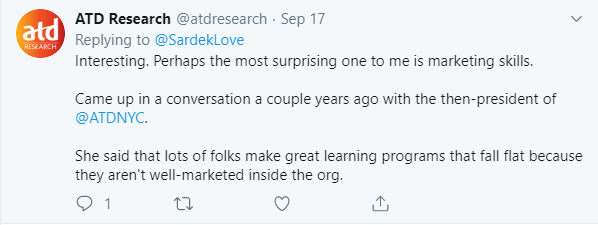
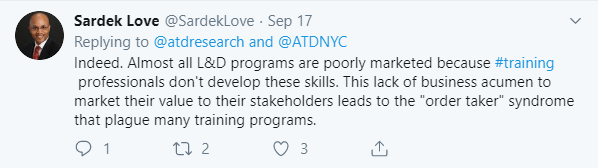
Last week a few tweets caught my eye. ATD released an bit of research on “Top 10 Skills to Get You Ahead in L&D” .  Number 8 on the list was marketing.  I was glad to see this.  While the Learning & Performance Institute identified Marketing and Communications in its L&D capability map, there is no mention of it in SHRM’s L&D Body of Competency and Knowledge. Sardek Love, I feel, correctly identified this skill as one of the gaps that can offer significant competitive advantage. Drawing this response form ATD.

ATD Marketing

Sardek Marketing

I touched on the need for this capability in 2018 in this blog post. I expanded my thoughts on this dimension in Running Training Like a Startup as an important driver of speed, Speed to Learner.

“In order to impact this dimension, we believe the mind-set of L&D needs to change from manufacturer to marketer. One look at attendance data will show you that the most attended trainings are frequently mandated, not sold, to their audience. Assuming that learning is solving a real problem, getting users to recognize and “buy” the solution quickly is critical. Running Training Like a Business means L&D must become marketers and packagers of a truly performance-inducing product. Like Gatorade® for employee performance.”

From course descriptions that ” sell benefits not features” to launches that capture and engage target audiences (think something than than cafeteria tables), L&D is fighting for mindshare.  Marketing can help us connect learners to learning and produce business impact in a world where learner attention is a rare commodity.


Rotting Boards

L&D Advisory boards need a fresh look.

The current geo-political landscape aside, the topic of governance, with its advice, consent and oversight functions, remains at the forefront of discussions for L&D.  In the book Running Training Like a Startup I cite a report done by NIIT and CorpU to find out how learning organizations have adopted the core principles of van Adelsberg’s and Trolley’s book. Two findings from the report which jumped out at me were in the area of governance.  The study found that:

  • The use of governing boards with C-level executives to ensure strategic alignment is fine in theory but has little effectiveness in practice. Sixty percent (60%) of the companies have them to some degree, but only 10% deemed them highly effective.
  • The use of more tactical advisory boards, while slightly less prevalent (59%), are more useful in that 17% of the respondents deem them highly effective. 

While this study is now aged, my recent discussions with clients have confirmed  that this remains a sub-optimized tool for learning organizations.  While many have a documented governance structure much fewer are gaining the benefit.  Most of L&D seems to acknowledge the generally accepted three-tier model for governance. Executives form the strategic executive level with business heads and line managers operating in increasingly tactical functions in the lower levels.

Earlier this year, Training Industry Magazine published  a “Learning Governance Framework Cheat Sheet” that had been developed by Kaplan.  While fairly common sense, lots of “uh-huh and not a lot of “ohhh”, one pithy item on the checklist stuck with me as much for the pithiness as the “how?” questions that remained unaddressed.

“Construct a governance structure that is inclusive, agile, and commercially pragmatic with senior leader advocacy.”

I am currently working to expand the governance section of the book based on recent experience and research.  But, for those that are currently operating advisory boards at any level here are a few questions worth considering.  These are taken and adapted from a set that Jerry Colonna, executive coach to founders and author of Reboot, uses to assess the boards of startups.

  1. When the shit hits the fan, which of your advisory board members would you turn to and why?
  2. If your advisory board was your executive team, what experiences or temperaments are missing?
  3. What skills would you like to see on your advisory board?
  4. How do non-advisory board executives and managers view your current advisory board?

In today’s fast moving business environment L&D cannot fail to get the most out of this critical element of driving unmistakable value for the companies they serve. How are you using advisory boards and what challenges are you facing in getting the most out of them?


Why Not Re-skill?

Why Not Re-skill? Recruitment vs. Re-Skilling

A survey from the Consumer Technology Association, the trade association representing the $398 billion U.S. consumer technology industry, which supports more than 15 million U.S. jobs and more than 2,200 companies stated the following:

  • 37% of those surveyed will displace workers due to technology advancements in the next five years.
  • Of those with displacements, only 52% of the displaced population will be re-skilled and retained!

My question is simple. Why will only half of the companies surveyed re-skill workers and choose instead to take the long, expensive, and risky path of recruitment?  Existing workers have already proven to be a culture fit.  They have cleared the hurdle of basic orientation to the way the company works.  They have already demonstrated the ability and desire to add their value to the company.  The tangible costs of new employees along with the intangible cost of layoffs to brand and public perception seem to far outweigh any costs associated with re-skilling.  So why the decision to jettison half of the displaced? How do executives view this trade off? What does this say about how L&D delivers re-skilling and the perceived value of it?

I look forward to your thoughts.

The Pause That Refreshes

Some thoughts on the value of taking a break.

I took the summer off.  I did this for several reasons.  First I took the break to focus on my health, both physical and mental. These are things that often find themselves on the back burner when a client challenge or passion project arrive on the scene.  The second reason was that after taking 18 months to research and write Running Training Like a Startup I had lost my perspective on the practices it contains.  Taking almost 90 days to work on myself initially felt like extravagant waste.  As the days passed it became increasingly clear that it was overdue and that I had come dangerously close to a place I did not want to be.

When my self allotted time began to come to a close I found myself quieter and able to hear my passion for rekilling today’s workforce.  I was growing increasingly confident in the path I had selected.  A confidence that had wobbled and waned prior the summer. I gave myself time to reflect on the learnings from client engagements and feedback I had received on the book. All in all it was an extremely valuable pause that I hope will make my future contributions that much more valuable to my readers, clients, friends and family.

The summer was not entirely without work.  I read and learned prolifically.  Articles, books, videos and conversations have fed my mind with ideas for blogs, book additions and activities.  You can look for the next version of the shareware book to be released in Q4 with expanded content on governance and minimal viable product design.  I am excited to share and get the advice of other practitioners.  You can see a curated selection of articles I have been reading here.

I recommend a pause to everyone.  It feels selfish.  It feels like a luxury that can’t be afforded. It feels amazing. Sometimes we forget our “why.”  Why we do what we do.  Applying the 5 Why’s exercise to our own actions can sometimes be a valuable check on the alignment that we have in our life and work.

Why I Do What I Do

I believe that learning is the silver bullet.  I believe it solves social and economic issues.  I believe it impacts terrorism and global issues.  I believe that it is the single most important driver in ensuring our future is better than our present.  I believe that Running Training Like a Startup is my contribution to improving the bullet.

The Accountable Chair

The mission of a company’s L&D organization is to provide the business with a skilled workforce that enables it to achieve its business goals.  In a tight job market, the ability to upskill the workforce takes on an even more critical role.  The costs of new hires are high.  Wage inflation, time to productivity, culture fit (or first-year attrition due to the lack of it) are only two components of this cost equation.

So in this environment think about this. As L&D continues to ask for a “seat at the table.”

“Layoffs hit their highest level for a first quarter in 10 years as 2019′s job market got off to a shaky start, according to a report Thursday from outplacement firm Challenger, Gary & Christmas.

Total announced cuts hit 190,410, a 10.3 percent increase from the fourth quarter, and a 35.6 percent jump from the same period a year ago. The level was the worst period overall since the third quarter of 2015 and the highest level for a first-quarter since 2009 as the economy was still mired in the financial crisis.”

-Jeff Cox, CNBC

And that is not to mention the lost revenue and growth opportunities due to the mountain open positions.

And yet when you Google “CLO’s fired” you get ZERO results. I understand that many factors play into layoffs and but with automation increasing and the digitization of the workplace sweeping overall business sectors shouldn’t we all be targeting the lowest layoff levels and job openings possible.  With a seat at the table will come accountability.  Are we ready for it?

Who’s the Boss?

This article referencing data from McKinsey hits on an important point regarding the importance of governance.  If we (as an industry) can figure out a solid  model for the governance of L&D, I am all for it.  But after two decades of hearing “we need a seat at table,” I am bored and a bit pissed. It is time to be bold and loud and get fired.  I address governance in the book but more importantly this article highlights why we have to get it. Credibility, resources and respect flow from having EARNED the right with senior sponsors.

I proposed three levels of of governance ( strategic, tactical and specific) but I seriously don’t care. The goal is connecting to the business. The goal is understanding the business. I remember Ed Trolley calling this disconnect out  by always asking learning leaders  whether, “if the company goes out of business, are you (L&D) sill around?”  The L&D organization is part of a larger whole and thinking any other way is dangerous.

Fall in Love with the Problem

I was reading a recent article from the folks at Lean Startup and it hit a nerve as I began writing up some new ideas for the Running Training Like a Startup (RTLAS) v2.0  The article revisits a long held tenet of product development, “fall in love with the problem, not the solution.” This is similar to, “if all you have is a hammer everything looks like a nail.”  In RTLAS v1.0 I describe the importance of deeply understanding both the challenge and the learner as part of the design process.

As someone with a foot both inside and outside the learning industry I often feel torn.  My outside foot telling me that the industry is misaligned and in desperate need of a full reboot.  My inside foot knows many of the talented learning professionals and empathizes with the challenges they face. In fact, in 2010 when I first began writing my Learning Hacks blog to explore the connections between startup techniques and L&D I wrote a post originally titled, “This Industry Needs an Enema.”

That said, judging by the literature, discussions, and personal experience the learning industry is deeply in love with solutions and only friendly with the problems being faced by businesses today. We know have many more tools in our toolbox than just a decade ago.  In fact keeping up with all the tools can be a full-time job. But just as “convert it all to elearning” was a hammer looking at a course catalog of nails, the industry needs to remember that great solutions come from loving the problem. Let’s at least be “friends with benefits” with it.

What are your thoughts?


Open Source

I just re-read Walter Isaacson’s “The Innovators”, a wonderful history of the people and events that made the digital age possible. In it he describes the creation of the software industry and the early formation of two camps. One thought that software should be free, describing the hobbyists that openly shared code between another. He even noted that that Wozniack’s early schematics for what would become the core of the Apple 1 computer were given away free by Woz at community meetings. The second camp, characterized best by Bill Gates, saw the protection of intellectual property as key to supporting future innovation.

For the open community, allowing innovations to be shared allowed for rapid adoption and accelerated advancement. Innovators didn’t need to recreate a solution that had already been found and could instead focus on building upon it. Also, by adopting an open approach an entire community became an extension to the development team. The opposing camp felt that without compensation innovation could not be supported. I see both sides and as a former interim-CEO for a music technology company, an industry where rights are front and center, feel strongly that the creator has the right to choose, and that choice must be respected.

As I came to complete the book Running Training Like a Startup I realized that I now had to make this choice. I could publish the book, thereby monetizing my efforts or I could give it away. When I work with startups I often refer back to a presentation on startup success that I saw during the first dotcom run that simply stated CFIMITYM. Cash flow is more important than your mother. Without cash flow, a startups life is on the clock. Many startups, even those so-called “unicorns” that are now going public, often chose another path. Monetization slows growth and adoption. “We can always monetize once we have a million users,” they say. And so, the freemium model, where there is a free tier of services available, was born. Once a user has seen the value of the product, they can upgrade to a paid tier later. When I was at Forum we called this “earning the right” in our sales training.

I believe strongly in the value that Running Training Like a Startup can contribute to the industry. I think that upskilling is the number one challenges facing the world. I believe that more minds, not a select few, will accelerate our industry’s ability to overcome this challenge. I also know that at the pace of business today reinventing the wheel will not cut it. For this reason, I have decided to open source the book. Feel free to download it, share it, discuss it, build on and improve its concepts with your own. I will be doing the same. This blog will continue to document my evolving thoughts on the concepts presented in v1 and I am committed to sharing my learnings with our community. All I ask is that you do the same.

Open source book here

Here Comes the Book

As I completed the v1 of Running Training Like a Startup I realized that during every review cycle I wanted to add in something new I had read about or experienced in my work with startups. In the lingo of early stage companies this is called “feature creep”. Reminding myself that this book (product) and its concepts (features) were in fact startups of their own I set a v1 release date and stopped. I feel strongly that the opportunity for learning organizations to deliver more value by adopting startup techniques. But the ideas I have captured offer no value to the industry sitting on my hard drive. More on the release in a few days. 

In order to offset my feature creep, I have identified 10 key threads that run through the book and will continue to update the here on this blog. For readers of the book this will offer a simple way to delve deeper into any particular or to see the evolution of that idea since the release of v1. As appropriate content will be integrated into future product releases. The ten threads covered in the book and incubated here are:

· Founders

· Founding Team

· Pitching and Communications

· Experiments

· Failure

· Product Management

· Speed

· Data

· Organizational Framework

· Tools and Resources

I look forward to the release and to watching how this approach can transparently grow the approaches to delivering unmistakable value.